

El Salvador has issued over 70 DASP licenses as of 2026. Tether moved its headquarters there. Bitfinex Securities operates from San Salvador. The CNAD processes applications from exchanges, custodians, and token platforms every month.
But not every crypto license service provider delivers the same results. Some get applications approved in four months. Others stretch the timeline to nine months or longer.
We compared five firms that actively handle El Salvador licensing. The comparison looks at published pricing, included services, local presence, and what happens after the license lands.
Here is what we found.
The Comparison Table
Six categories separate the good firms from the rest. Local office access. Pricing transparency. Compliance officer placement. Bank account support. Post-license services. The table below shows how each firm stacks up across those five areas.
| Firm | Local Office | Published Pricing | Compliance Officer Placement | Bank Account Support | Post-License Services |
| Gofaizen & Sherle | Yes | Yes (three tiers) | Yes | Yes (Full package) | Dedicated follow-up group |
| COREDO | No | Yes (three tiers) | Yes (4 months included) | Yes (Full package) | Accounting legalization |
| Tetra Consultants | No | Contact-based | Yes (core service) | Yes | Ongoing compliance monitoring |
| Intelium Law | No | Contact-based | Yes (two AML officers) | Yes | Regulatory change alerts |
| Manimama | No | Contact-based | Yes (Premium tier) | Yes | Shared compliance calendar |
The table shows who offers what at a glance. Now, let’s look at how each firm handles the work. The differences show up in the details.
1. Gofaizen & Sherle
Working as a specialized crypto licensing firm in El Salvador, Gofaizen & Sherle keeps a physical office locally. When the CNAD requests a signed document by 5 PM, someone delivers it. No waiting for couriers. No explaining time zones.
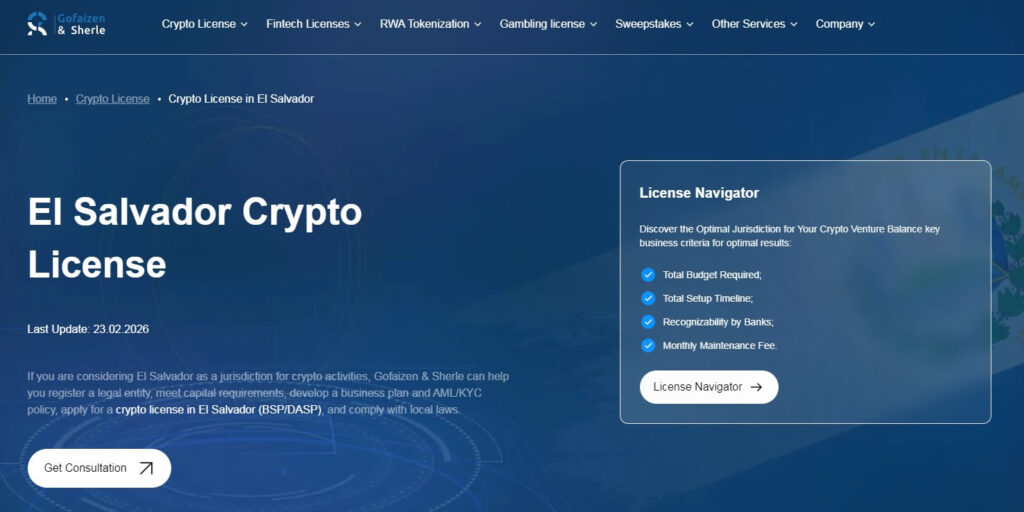
Gofaizen & Sherle experts recommend running your business model through their internal assessment before selecting any jurisdiction. The firm examines budget constraints, expected timelines, banking accessibility, and monthly overhead. El Salvador appears at the top for some business types and lower for others.
The firm’s crypto lawyers deliver legal consulting services for crypto business setup across three distinct tiers. The Basic package at $12,400 covers BSP registration for Bitcoin-only operations. The Advanced package at $28,900 adds DASP compliance for multi-asset exchanges. The Full package at $37,200 includes office setup and ongoing accounting.
Three things that set them apart:
- Document delivery speed. Their local office processes apostilles and translations in days, not weeks. Foreign firms without local presence wait 14 to 21 days for the same documents.
- Officer replacement pipeline. If a placed compliance officer leaves within the first year, Gofaizen & Sherle provides a replacement candidate within ten business days. Officer turnover kills compliance continuity. This guarantee keeps your license active.
- Regulator meeting preparation. The CNAD sometimes interviews compliance officers before approval. Gofaizen & Sherle runs mock sessions based on actual questions from recent applications. Their officers have sat through those interviews before.
The lawyers for obtaining crypto license at Gofaizen & Sherle have worked across more than 50 jurisdictions. Each application taught them something new about how regulators review different business models.
2. COREDO
COREDO operates from Prague and delivers legal service to obtain a crypto license in El Salvador through three structured tiers. Each tier adds more infrastructure. Clients choose based on their business complexity and budget.
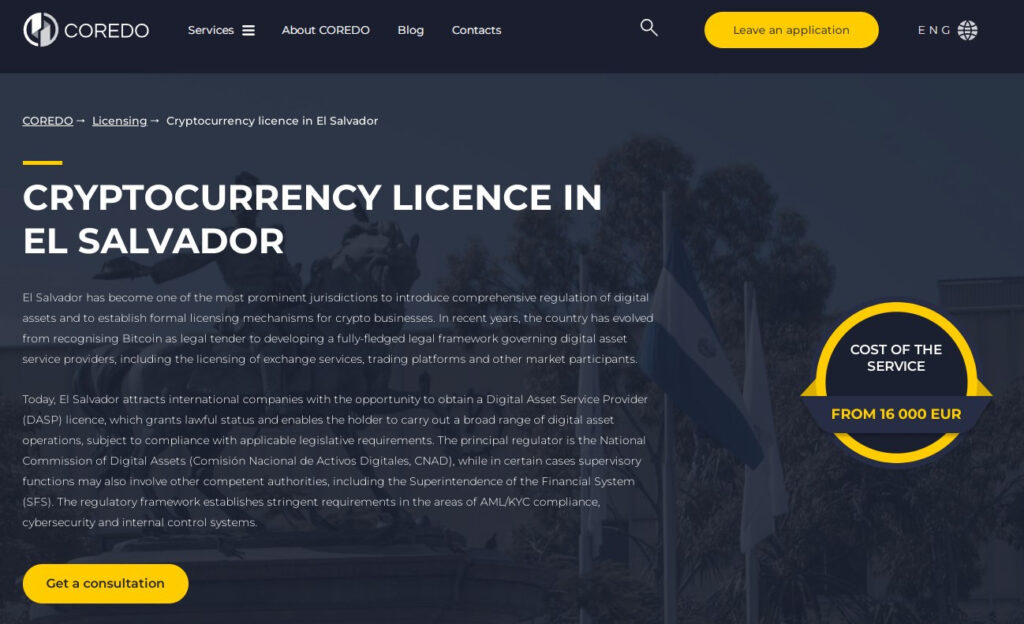
The Basic tier at €16,000 covers company formation, standard AML/KYC policies, and assistance with BTC license registration. The Advanced tier at €37,000 adds personalized policies, local compliance officer placement, and eight internal procedure documents. The Full tier at €47,500 includes everything plus office setup, accounting, and corporate bank account opening.
COREDO acts as a specialized legal firm for obtaining crypto license with particular strength in documentation preparation.
Three things that set them apart:
- Eight-policy document package. The Advanced tier includes Enterprise-Wide Risk Assessment, Business Continuity Policy, InfoSec Policy, Winding Down Policy, Compliance Management Policy, Risk Management Policy, Safeguarding of Assets, and Code of Ethics. The CNAD expects to see all eight. COREDO drafts each one for your specific operation.
- Employment contract structure. COREDO places compliance officers under direct employment agreements with your company, not as contractors. The CNAD checks for actual authority. Contractors cannot stop transactions or freeze accounts. Direct employees can.
- UIF registration separation. The Financial Investigation Unit handles AML oversight. Registering with the UIF requires a separate application from the CNAD license. COREDO’s Full package includes this step. Many providers forget it entirely.
The legal crypto consulting at COREDO connects El Salvador licensing to European compliance frameworks. Their Prague base means they understand MiCA requirements. Clients expanding from Europe to Latin America deal with one firm instead of two.
3. Tetra Consultants
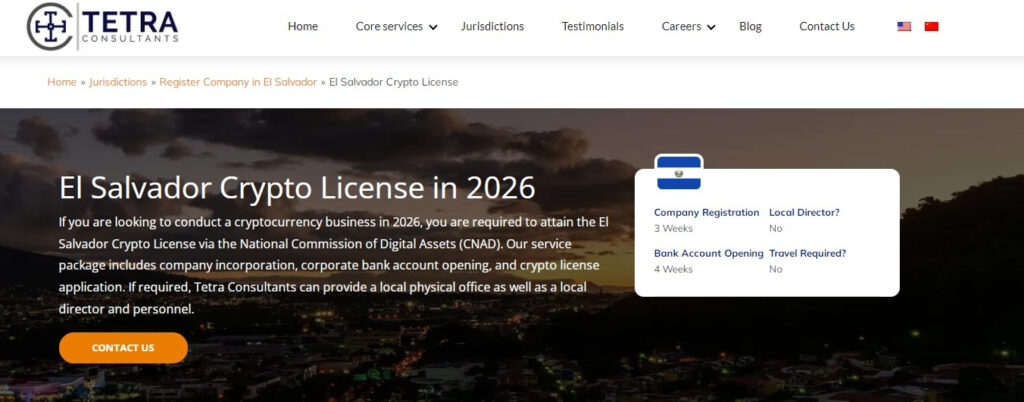
Tetra Consultants builds their El Salvador practice around a simple observation. Most crypto founders understand trading, wallets, and tokenomics. Very few understand Salvadoran labor law, social security registration, or ministry-level tax filings.
Tetra fills those gaps.
The firm acts as a legal consulting firm for crypto business that handles the non-sexy stuff other providers ignore. The stuff that gets your license suspended if you miss a deadline.
Three things that set them apart:
- Fifteen-day compliance window. After company registration, you have 15 calendar days to register with Hacienda (tax authority), the Salvadoran Social Security Institute, and the Ministry of Labor. Miss one deadline and your application stops. Tetra tracks these windows and files the paperwork before the clock runs out.
- NIT and RNC acquisition. Every licensed crypto company needs a Tax Identification Number (NIT) and Taxpayer Registration Number (RNC). Tetra obtains both during the company formation stage. Many firms wait until after incorporation. That delays the CNAD application by weeks.
- Social security for compliance officers. The two local compliance officers required for a DASP license must be enrolled in the Salvadoran social security system. Tetra handles the enrollment paperwork. Officers cannot start work without this step completed.
The lawyers for obtaining crypto license at Tetra also manage the paid-up capital verification. The minimum share capital is $2,000 with 5% paid up at registration. Tetra works with local banks to confirm the deposit and generate the verification letter the CNAD requires.
Tetra provides legal consulting services for crypto business setup that focuses on the administrative infrastructure most firms overlook. The CNAD notices when those details are handled correctly.
4. Intelium Law
Intelium Law operates as a legal consulting firm for crypto business with a dedicated El Salvador practice. Their team includes lawyers who previously worked at Ernst & Young, bringing Big Four compliance experience to crypto licensing.
The firm handles the full DASP application process. Company formation. Policy drafting. CNAD submission. Bank account opening. Their published timeline shows 3 to 6 months from start to approval.
Intelium positions itself as a specialized legal firm for obtaining crypto license that stays involved after the license is obtained. Each client gets a dedicated manager who monitors regulatory changes and flags risks early.
Three things that set them apart:
- Twenty-business-day CNAD review window. Once Intelium submits your complete application, the CNAD has 20 business days to conduct their substantive review. That is a published timeline, not a guess. Intelium structures every submission to survive that review without triggering clarification requests.
- Two AML officer requirements are built into the package. The DASP license requires at least two certified AML officers. One must be locally based in El Salvador. Intelium handles the recruitment, certification verification, and registration with the Financial Investigation Unit as part of their service.
- Policy-to-operation gap analysis. Before submitting anything to the CNAD, Intelium runs an audit of your existing operations against Salvadoran requirements. You find out what is missing before the regulator tells you. That means fewer “please resubmit” emails and faster approvals.
The lawyers for obtaining crypto license at Intelium have structured deals across Europe, the UAE, and Latin America. Their El Salvador practice connects to a larger network that includes MiCA licensing in Poland, Lithuania, Cyprus, and the Czech Republic. Clients who want El Salvador now and Europe later do not need to switch firms.
5. Manimama
Manimama does not dilute their practice with gambling licenses or forex applications. Every client runs a crypto business. Exchanges. Wallets. Token issuers. That focus shows up in their document templates.
The firm lists El Salvador in their “fastest registration” category. Their website puts El Salvador alongside Lithuania, Poland, Cyprus, Malta, Canada, the UAE, and Switzerland. The firm has seen approvals move quickly there for prepared applicants.
Manimama divides their El Salvador service into Premium, Advanced, and Basic packages. Each tier adds more infrastructure. The Basic package suits Bitcoin-only operations. The higher tiers add full DASP compliance and local officer placement.
Three things that set them apart:
- Industry-specific policy drafting. The firm’s document templates address exchange cold wallet procedures, token issuance compliance, and custodial asset segregation. Generic templates from firms serving multiple industries miss these details. Manimama’s templates come from crypto-only experience.
- Startup-friendly entry point. El Salvador has no minimum capital requirement for BSP registration. Manimama markets this advantage directly. Their Basic package reflects the lower compliance burden for Bitcoin-only services. Startups do not pay for DASP infrastructure they do not need yet.
- Shared compliance calendar. Every client gets access to a shared calendar. Hacienda filing dates. Social Security payment deadlines. CNAD quarterly report due dates. The calendar sends alerts seven days before each deadline. Clients never ask “what is due next month.”
Manimama acts as a specialized legal firm for obtaining crypto license that treats El Salvador as one jurisdiction in a larger European expansion map. Their EU base means clients can handle MiCA compliance and the DASP application through the same firm. A client licensed in El Salvador who wants to add Lithuania or Poland next stays with the same team.
Best for: European crypto projects that want a crypto-only focused firm, startup-friendly entry pricing, and a shared compliance calendar to track ongoing deadlines.
What We Learned From Comparing These Firms
The table and descriptions show clear differences. Some firms maintain local offices. Others operate remotely. Some publish every price. Others require a conversation first.
But three patterns emerged that matter more than pricing or office locations.
First, compliance officer placement separates the serious firms from the rest. The DASP license requires two local compliance officers. Finding qualified candidates in El Salvador is hard. Firms that maintain pre-vetted candidate pipelines get licenses approved faster than firms that start the search after signing the contract.
Second, bank account support is not optional. Licensed crypto firms need corporate accounts. Salvadoran banks change their crypto policies quarterly. A firm that has not placed a client in the past six months does not have current information about which banks are accepting new DASP clients.
Third, post-license support varies dramatically. Some firms disappear after the approval arrives. Others schedule compliance reviews before the license even lands. The CNAD circles back with questions in the first six months. The firms that stay ahead of those questions keep their clients licensed.
Final Thoughts
El Salvador’s DASP framework survived the IMF deal. The 2025 Bitcoin Law amendments did not touch the LEAD legislation. The CNAD continues issuing licenses. The 0% corporate tax rate on crypto income remains law.
More than 70 entities already operate with DASP authorization. Tether relocated its headquarters to El Salvador. Bitfinex Securities runs a licensed operation from there.
The window for fast approvals is still open. But the CNAD has seen hundreds of applications now. They know which documents to check. They know which compliance gaps to look for. They know which business models raise red flags.
The five firms compared here have all submitted applications recently. Not three years ago. Recently. They know what the CNAD asks for in 2026 because they have seen the questions.
Pick the firm that matches your business model and budget. But pick one. Operating without a license in El Salvador is not a viable option anymore.